Quest-On
AI assessment SaaS deployed in live university exams
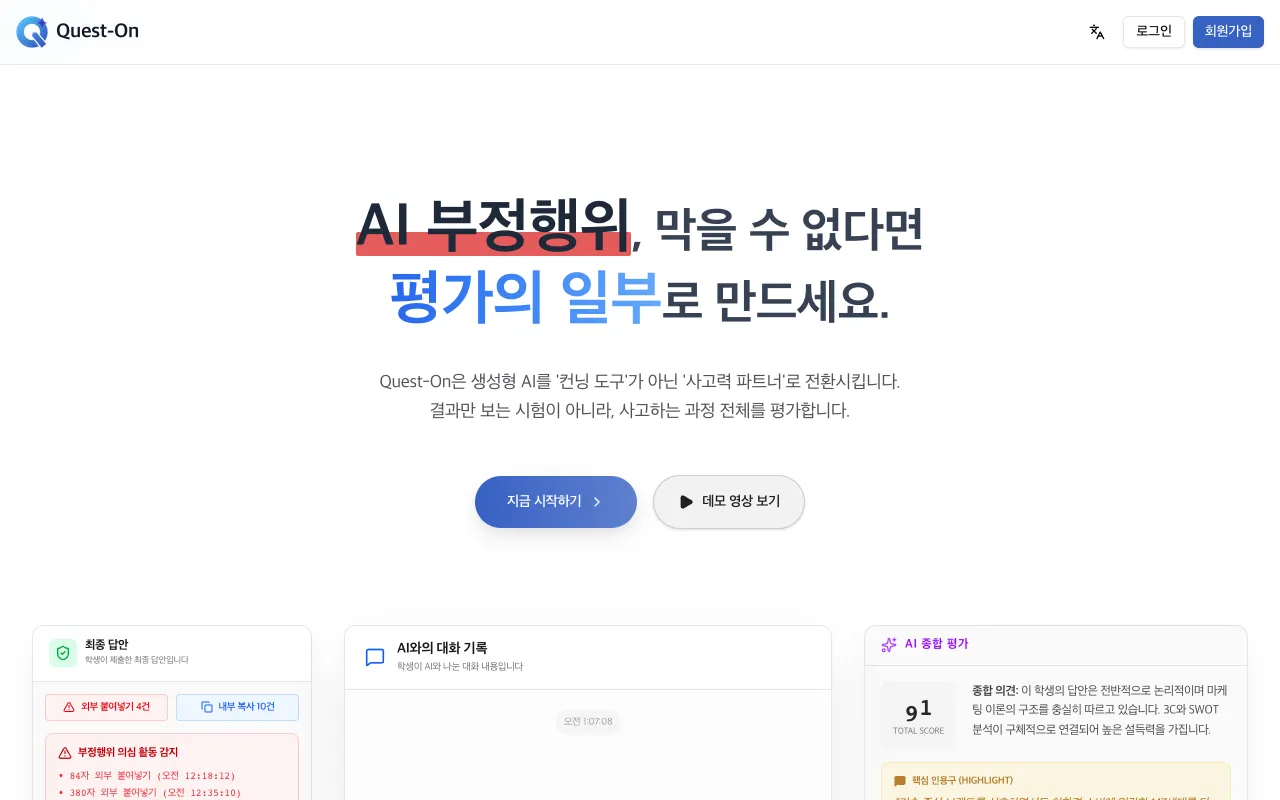
End-to-end AI assessment product for instructors and students—from exam authoring and live sessions to rubric-based AI evaluation and result review.
Overview
- My role
- Co-Founder & Lead Product Engineer
- Team
- Student founding team — Justin owned product engineering; business-development co-founder owned outreach and commercial ops
Operational context
Instructors grading open-ended answers that require reasoning spend too much time, and criteria can drift between graders. Live exams also need permissions, session state, and reliable result handling—not just a demo chatbot.
Users & stakeholders
- Instructors authoring exams and reviewing results
- TAs supporting exam operations
- Students taking live assessments
Problem
Grading open-ended reasoning is slow and inconsistent, and instructors struggle to give timely feedback while still running a trustworthy exam workflow.
Constraints
- Must work in real academic exam conditions, not only demos
- Role-based access for instructors, TAs, and students
- Rubric-aligned evaluation and reviewable results
- Small founding team — product engineering owned end-to-end by Justin
My ownership
- Translated academic assessment workflows into product requirements, data models, and shippable features
- Designed and implemented frontend, backend, permissions, exam flow, and AI evaluation paths
- Owned deployment and live-exam operations support
- Made technical decisions on auth, data, and LLM application architecture
Discovery
- Partnered with the business-development co-founder, who gathered instructor interviews and adoption requirements
- Converted those field requirements into exam authoring, session, evaluation, and review features
Build timeline
Core Build
Within one monthShipped the core E2E flow—exam authoring → sit-down exams → AI evaluation → result review—and began initial validation.
Production Hardening
About three monthsHardened role-based access, assessment structure, data flows, rubric-based evaluation, and operations features for live exam use.
Live Operation
After hardeningOperated the finished product in live university exam environments and incorporated instructor and user feedback.
Measured Outcome
Live examsAutomated rubric evaluation cut grading work from about 10 hours to about 2 hours.
Solution
Built a production assessment SaaS covering exam creation, student sessions, role-based access, rubric-based AI evaluation, and instructor review—so grading support sits inside the real exam workflow.
System architecture
Next.js application on Vercel with PostgreSQL via Supabase, Clerk authentication, Prisma-backed data access, and OpenAI-powered evaluation/feedback flows.
- Exam authoring and session management UI
- Role-aware authentication and access control
- Submission and result data model on PostgreSQL
- Rubric-based AI evaluation across chat and answer stages
- Instructor review and feedback surfaces
Key decisions
Productize the full exam workflow
A grading demo alone would not survive live academic use.
Ship authoring, permissions, sessions, evaluation, and review as one system.
Trade-off: Broader scope slowed polish on secondary features, but made real exams possible.
Rubric-grounded AI evaluation
Open-ended answers need consistent criteria instructors can inspect.
Bind AI scoring/feedback to instructor-defined rubric areas and keep results reviewable.
Trade-off: More authoring work for instructors, higher trust in outputs.
OpenAI API application layer (not research training)
The goal was a deployable assessment product, not a foundation-model research stack.
Use LLM APIs inside a product workflow with structured prompts and stored results.
Trade-off: Less custom model control; faster path to production value.
Deployment & operations
Operated the platform during live academic exams—preparing sessions and permissions beforehand, monitoring during exams, and reviewing results afterward with instructors.
- Pre-exam setup for accounts, roles, and exam configuration
- Live-session checks during academic exams
- Post-exam result review and iteration on repeated needs
Measured impact
Lessons
- Field requirements from BD outreach only become product value after they are turned into permissions, flows, and reviewable outputs.
- For assessment products, trust comes from rubric alignment and instructor control—not from sounding smart.